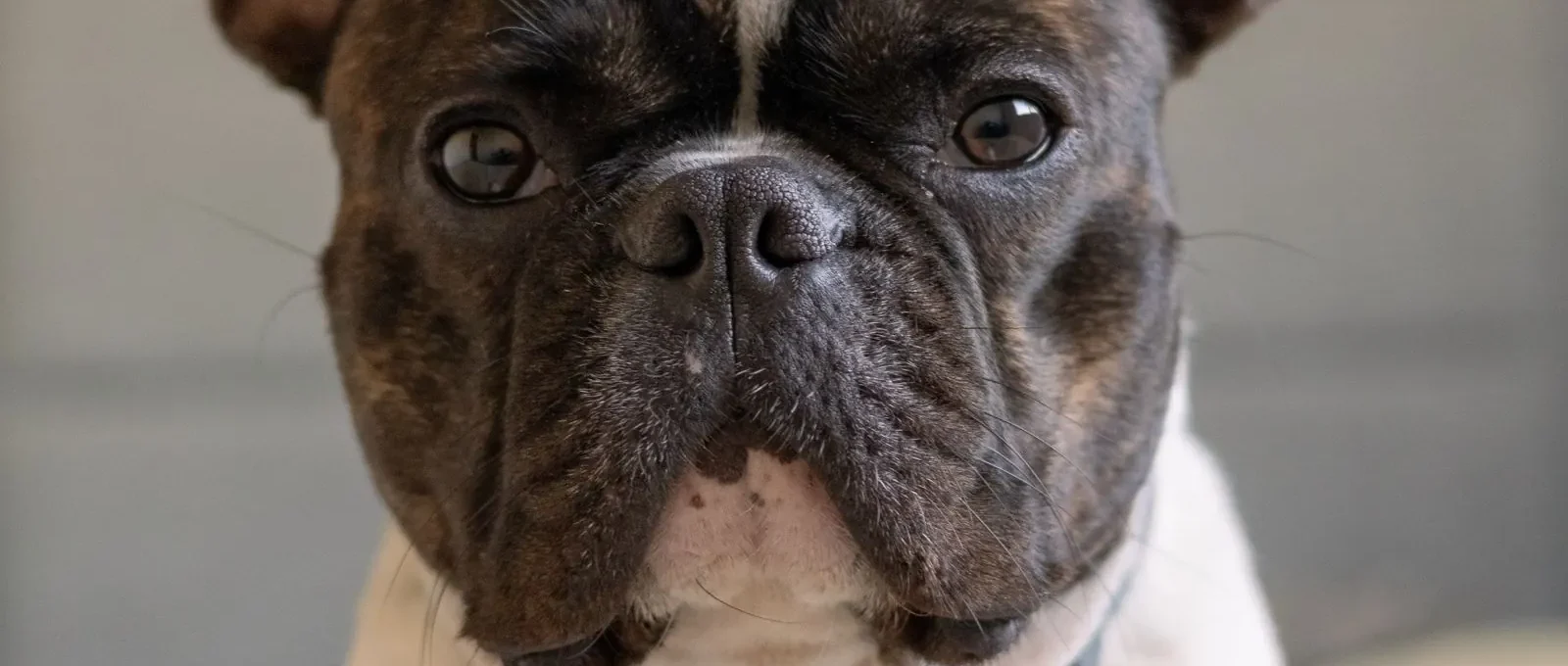

French Bulldogs are the most expensive dog breed in America to insure, and it is not close. Insurify’s breed medians — drawn from more than 250,000 quotes — put a French Bulldog at $69 a month with a $5,000 annual limit and $134 a month with unlimited coverage, against a median of $43 a month for dogs overall. The reason is anatomy. The breed’s flat face makes breathing problems likely, its spine is prone to disc disease, and its joints, eyes and skin all fail more often than average. Insurers know the claims history and price it in from day one — or protect themselves with waiting periods and exclusions aimed at exactly the conditions Frenchies get.
That fine print is where French Bulldog insurance is won or lost. Two policies at the same monthly price can treat a cruciate tear, a slipping kneecap or a breathing surgery completely differently: one pays after a 14-day wait, another excludes any orthopedic problem that shows up in the first six months — for the life of the policy. So this page does two things most breed pages don’t. It names the providers worth quoting, with their waiting periods, deductible options and pre-existing rules stated plainly. And it prices them on one standard basis wherever a standard-basis figure exists — a $5,000 annual limit, a $500 deductible and 80% reimbursement — with every other figure labelled with the basis it actually uses.

Best Pet Insurance for French Bulldogs: The Picks
ASPCA Pet Insurance — Best for Fast Orthopedic Coverage
Terms that matter for a Frenchie: Accident wait 14 days; illness wait 14 days; orthopedic wait 14 days — ligament and knee conditions carry the same 14-day wait on Complete Coverage, with no extended orthopedic waiting period. Deductible options $100, $250, $500 or $750, annual. Curable pre-existing conditions can be covered again after 180 days cured and symptom-free — except knee and ligament conditions, which never regain eligibility if they occurred before coverage started.
Good: The shortest orthopedic wait on this page, tied with Pumpkin, and the cheapest verified price (see the table below). The base plan includes hereditary conditions, exam fees, dental illness and alternative treatments without add-ons.
Watch out: The bilateral knee rule. ASPCA treats ligament and knee conditions as bilateral and related, so a knee problem on one side before enrollment affects coverage on both sides.
Skip if: Your Frenchie already has a documented knee or ligament problem — it will never become eligible, on either leg.
Pumpkin — Best All-Rounder
Terms that matter for a Frenchie: A single 14-day waiting period covers accidents, illnesses and orthopedic conditions — knee injuries and hip dysplasia included, with no extended orthopedic wait. Deductible options $100, $250, $500 or $1,000, annual. Curable pre-existing conditions (Pumpkin’s examples are a UTI or a paw fracture) are covered again after 180 symptom- and treatment-free days — except knee and hind-leg ligament conditions, which never regain eligibility.
Good: No orthopedic trap door: the conditions Frenchies are known for — hips, knees, spine — are all on the same 14-day clock. Pumpkin Now can pay qualifying claims over $500 the same day, at the vet.
Watch out: Fewer ways to tune the policy than some rivals — two reimbursement rates and a short list of deductibles and limits, so balancing premium against protection is coarser.
Skip if: You want a very high reimbursement rate or a highly customized plan structure.
Lemonade — Best for a Young Frenchie on a Budget
Terms that matter for a Frenchie: Accident wait 2 days; illness wait 14 days; orthopedic wait 30 days, but 6 months for cruciate ligament events. Deductible options $100, $250, $500 or $750, annual. Curable pre-existing conditions can come back after 12 months symptom-free; chronic and joint conditions never come back. Lemonade publishes its own French Bulldog averages: $70–$75 a month at ages one and two, rising to $130–$135 by age seven.
Good: Accident coverage starts in 2 days, the app-based claims process is fast, and the published puppy and young-adult prices are among the lowest around.
Watch out: The 6-month cruciate wait is the longest orthopedic wait among the cheaper picks. Exam fees, dental illness and physical rehabilitation — rehabilitation matters after IVDD — are add-ons, not base coverage.
Skip if: Your Frenchie is already showing knee stiffness or has any cruciate history; six months is a long time to be uninsured for the breed’s commonest joint failure.
Fetch — Best If You Enroll a Puppy and Get the Knee Exam
Terms that matter for a Frenchie: No waiting period for accidents from an unexpected event; 15 days for illness and for injuries from normal activity. The catch is orthopedic: the orthopedic waiting period is 180 days, and a condition that starts in that window is excluded for the life of the policy. The knee part of that wait can be waived if a vet examines your dog’s knees in the first 180 days and clears them. Deductibles are quote-dependent; Fetch’s published menus list $300, $500 or $700 for dogs, annual.
Good: Broad coverage once you are past the window, and accident cover from day one. Enrolled as a young puppy — with the knee exam done on time — the orthopedic trap largely disappears.
Watch out: That 180-day rule is the harshest orthopedic term on this page. A luxating patella or cruciate problem that first shows at month four is not just unpaid — it is excluded forever.
Skip if: You are insuring an adult Frenchie, or one whose knees have never been examined. The window risk is real and permanent.
Nationwide — Best for a Custom-Built Plan
Terms that matter for a Frenchie: Coverage starts 14 days after approval and payment for most plans. The orthopedic term is the hard part: a 12-month waiting period for cruciate ligament and meniscal damage in the first policy term, and it cannot be waived by a vet exam. Deductibles run from $100 on some plans; most owners choose $250, annual. Curable pre-existing conditions can be covered again after 6 months cured and treatment-free, with vet records to prove it.
Good: A long-established insurer with modular plans you can shape, and a clear, documented route back for curable conditions.
Watch out: Twelve months is the longest cruciate wait here — a full year in which the breed’s most likely joint surgery is on you.
Skip if: Knee coverage soon matters more than plan flexibility.
Pets Best — Best for a Low Deductible
Terms that matter for a Frenchie: Accident wait 3 days; illness wait 14 days; 6 months for cruciate ligament events. The widest deductible menu on this page — $50, $100, $200, $250, $500 or $1,000, annual — which lets you trade a low out-of-pocket cost per claim against a higher premium. On pre-existing conditions, be careful: Pets Best’s binding policy form sets no fixed cure period and decides eligibility case by case; the company’s consumer guidance describes curable conditions regaining cover after 180 days symptom- and treatment-free, with knee and ligament conditions excluded.
Good: The $50 deductible option is genuinely rare, and the 3-day accident wait is short.
Watch out: The 6-month cruciate wait, and the gap between the 180-day guidance and what the policy form actually promises on curable conditions.
Skip if: You need a contractual guarantee — in writing — about when a past condition becomes coverable again.
French Bulldog Insurance Prices Compared
The standard basis for this table is an accident-and-illness policy for a French Bulldog with a $5,000 annual limit, a $500 deductible and 80% reimbursement. The ASPCA, Pumpkin and Lemonade prices are MoneyGeek’s averages on exactly that basis (quote analysis updated October 29, 2026). Where a provider is not in that dataset, the table uses its best published breed figure instead, and the Notes column says what that figure actually is. On the same standard basis, MoneyGeek’s average across all providers is $90 a month — a useful yardstick, because every provider below beats it. For the wider picture of what moves premiums, see our full guide to pet insurance costs.
| Provider | Monthly cost (basis in Notes) | Orthopedic/IVDD waiting period | Notes |
|---|---|---|---|
| ASPCA Pet Insurance | $57 | 14 days — ligament and knee conditions carry the same 14-day wait | MoneyGeek standard-basis average; cheapest verified price here |
| Pumpkin | $59 | 14 days — same wait for knee injuries and hip dysplasia | MoneyGeek standard-basis average |
| Fetch | $71 | 180 days — an orthopedic condition that starts in this window is excluded for life | Not a standard-basis figure: Fetch’s own published average across its French Bulldog policies, all plan types (2025 policies) |
| Lemonade | $74 | 6 months for cruciate ligament events; 30 days for other orthopedic conditions in most states | MoneyGeek standard-basis average; Lemonade’s own published average for a 1–2-year-old Frenchie is $70–$75 |
| Nationwide | $82 | 12 months for cruciate ligament and meniscal damage (first policy term) | Not a standard-basis figure: NerdWallet sample quote for a 2-year-old French Bulldog |
| Pets Best | $88 | 6 months for cruciate ligament events | Not a standard-basis figure: NerdWallet sample quote for a 2-year-old French Bulldog |
Two things these averages hide. First, age: MoneyGeek’s breed figures climb steeply as a Frenchie ages, and Lemonade’s own table runs from $70–$75 a month at age one to $130–$135 at age seven. Second, the annual limit: Insurify’s median for the breed nearly doubles, from $69 a month at a $5,000 limit to $134 with unlimited coverage. A cheap quote on a low limit is not the same product as a higher quote with room for a $5,000 surgery.
French Bulldog Health Problems and What Insurance Actually Covers
BOAS — the breathing problem
Brachycephalic obstructive airway syndrome is the cluster of airway defects the breed is bred with: narrowed nostrils, an elongated soft palate, sometimes a narrow windpipe. It is why Frenchies snore, snort, overheat and tire quickly, and in moderate to severe cases the fix is surgery. PetMD prices BOAS corrective surgery at $2,000 to $5,000 or more.
What insurance does with it: BOAS is a hereditary, breed-typical condition, so what matters is (a) whether the policy covers hereditary conditions in the base plan — ASPCA’s does, and Lemonade states its base policy can cover BOAS that develops after enrollment — and (b) whether your dog’s breathing was already documented before you enrolled. Snoring, noisy breathing or a vet’s note about airways recorded before the policy starts can be treated as a pre-existing condition even without a formal BOAS diagnosis, and breathing conditions that count as chronic do not regain eligibility under the curable-condition rules at ASPCA, Pumpkin, Lemonade or Fetch. The practical rule: enroll before the first vet visit that puts breathing in the record, and check whether exam fees are covered or an add-on (at Lemonade, they are an add-on).
IVDD — the spine problem
Intervertebral disc disease is the breed’s other signature risk: a disc in the back slips or ruptures, causing pain and, in bad cases, paralysis. Lemonade’s French Bulldog guide puts average IVDD treatment at $2,500 to $8,000, and surgical cases sit at the top of that range.
What insurance does with it: IVDD is where waiting periods bite hardest, because a disc can go without warning. At ASPCA and Pumpkin, the standard 14-day wait is all that applies. Fetch’s 180-day orthopedic window is the danger zone — a spinal or joint condition that starts inside it is excluded for the life of the policy. AKC Pet Insurance is the one insurer in our dataset that names IVDD outright, with a 180-day waiting period for it. Post-surgery rehabilitation is part of IVDD recovery, so check whether physio is in the base plan or an add-on before you need it — at Lemonade, it is an add-on.
Cherry eye
Cherry eye is a prolapse of the gland in the third eyelid — a red lump in the corner of the eye that usually needs surgical repair. Lemonade’s French Bulldog guide puts average treatment at $500 to $900.
What insurance does with it: cherry eye is an illness, so it falls under the ordinary illness waiting periods — 14 days at ASPCA, Pumpkin, Lemonade, Nationwide and Pets Best, 15 days at Fetch. The trap is bilateral rules: several insurers treat paired-body-part conditions as one. AKC’s policy, for example, defines cherry eye as a bilateral condition, so a pre-existing case in one eye can affect the other. If your puppy has had one cherry eye repaired before you insure, ask the insurer — in writing — how the other eye will be treated.
Hip dysplasia
A malformed hip joint that grinds instead of gliding, causing pain, stiffness and arthritis. In Frenchies it is usually managed with weight control, joint medication and pain relief; severe cases are surgical. Costs vary too widely by case and region for a single honest figure, so the insurance question matters more than the price tag here: is the condition covered at all, and after how long?
What insurance does with it: hip dysplasia is an orthopedic, hereditary condition, so it follows each insurer’s orthopedic wait. Pumpkin applies the same 14-day wait to hip dysplasia as to everything else, and ASPCA’s knee-and-ligament wait is likewise 14 days. Fetch’s 180-day window applies — dysplasia that shows inside it is excluded for life. One warning from outside our picks, because Frenchie owners meet it often: Healthy Paws applies a 12-month waiting period to hip dysplasia specifically, and does not cover it at all for dogs enrolled at age six or older.
Patellar luxation — the slipping kneecap
The kneecap slides out of its groove, causing a skipping gait and, over time, arthritis. Mild cases are managed; severe cases need surgery. MoneyGeek’s veterinary cost data puts luxating patella treatment at $1,716 to $10,312.
What insurance does with it: this is a knee condition, so each insurer’s cruciate/knee terms are the ones that count. ASPCA and Pumpkin: 14 days. Pets Best and Lemonade: 6 months for cruciate ligament events. Nationwide: 12 months for cruciate and meniscal damage. Fetch: 180 days, with the knee wait waivable if a vet examines and clears the knees within the first 180 days. And remember the pre-existing side: at ASPCA and Pumpkin, a knee or ligament problem that predates the policy never regains eligibility — which is why a puppy’s first knee check matters.
How to Choose
Insuring a puppy (under six months). You hold the strongest hand: no vet record yet, every waiting period beatable. Enroll now, and almost any pick works — but Fetch only makes sense if you will actually book the knee exam inside the first 180 days, and ASPCA or Pumpkin remove the orthopedic worry entirely with 14-day waits.
Worried most about breathing. Prioritize hereditary-condition coverage in the base plan and enroll before any vet writes down a breathing observation. Check the exam-fee position — you will claim breathing-related exams — and treat any insurer that excludes brachycephalic conditions for the breed as a non-starter.
Insuring an adult with a vet history. Read the pre-existing rules before the price list. Curable conditions come back after 180 days at ASPCA and Pumpkin, 6 months with vet records at Nationwide, and 12 months at Lemonade; chronic and joint conditions generally never come back. The one exception in our dataset is AKC Pet Insurance, which covers pre-existing conditions — including incurable ones — after 365 days of continuous coverage. If your Frenchie already has a diagnosis, that single term may outweigh every price in the table.
On a tight budget. Start with the standard-basis prices: ASPCA at $57 and Pumpkin at $59 are the cheapest verified figures here, and both carry 14-day orthopedic waits, so the saving does not come with an orthopedic catch. Lemonade’s young-dog prices are competitive, but price in the add-ons if you want exam fees or rehabilitation covered, and respect the 6-month cruciate wait. Whatever you choose, do not buy down the annual limit too far: one BOAS or IVDD surgery can consume a $5,000 limit in a single event.
Frequently Asked Questions
Does pet insurance cover BOAS surgery for French Bulldogs?
Yes, at most major insurers — if the condition was not pre-existing and the waiting periods have passed. BOAS is a hereditary condition, so the policy must cover hereditary conditions in the base plan (ASPCA’s does; Lemonade states its base policy can cover BOAS that develops after enrollment). Corrective surgery typically costs $2,000 to $5,000 or more (PetMD). The common failure mode is timing: breathing signs recorded by a vet before enrollment can make BOAS pre-existing even without a formal diagnosis.
How long do I have to wait before IVDD is covered?
It depends on the insurer, because IVDD falls under each policy’s illness and orthopedic terms. At ASPCA and Pumpkin the wait is 14 days. Fetch applies a 180-day orthopedic window, and a condition starting inside it is excluded for life. AKC Pet Insurance names IVDD explicitly with a 180-day waiting period. Nationwide’s 12-month wait applies to cruciate ligament damage rather than IVDD itself, but it is the figure owners most often confuse with a spinal wait. Enrolling a puppy, before any back symptoms exist, is the only way to make the wait irrelevant.
My Frenchie already snores and a vet has mentioned its airways. Is BOAS now pre-existing?
Quite possibly, yes. Insurers define pre-existing conditions by signs and symptoms in the medical record, not only by formal diagnoses, and a vet’s note about noisy breathing or narrow nostrils can be enough. Breathing problems also tend to count as chronic, which means the curable-condition routes back — 180 days symptom-free at ASPCA and Pumpkin, 12 months at Lemonade — generally do not apply. The exception is AKC Pet Insurance, which makes pre-existing conditions eligible after 365 days of continuous coverage, including incurable ones. Get the insurer’s position in writing before you rely on it.
How much does French Bulldog insurance cost per month?
On a standard basis — $5,000 annual limit, $500 deductible, 80% reimbursement — MoneyGeek’s quote analysis averages $90 a month across providers for the breed, with ASPCA at $57, Pumpkin at $59 and Lemonade at $74. Insurify’s medians tell the same story from the other side: $69 a month at a $5,000 limit, $134 with unlimited coverage. Puppies and young adults cost less; by age seven, Lemonade’s own average for the breed reaches $130–$135 a month.
When should I insure a French Bulldog puppy?
As early as the insurer allows — most enroll from around eight weeks. Every reason points the same way: premiums are lowest, no vet record exists to create pre-existing conditions, and the waiting periods (14 days at ASPCA and Pumpkin; 180 days for Fetch’s orthopedic window) run while your puppy is young and healthy. If you choose Fetch, mark the date for the knee examination that can waive its knee wait — it must happen within the first 180 days.
Is a $5,000 annual limit enough for a French Bulldog?
It is the minimum worth having, not a comfortable one. BOAS surgery runs $2,000 to $5,000 or more, and IVDD treatment averages $2,500 to $8,000 — either can consume a $5,000 limit in a single event, leaving nothing for the rest of the year. If the premium difference is manageable, a $10,000 or unlimited limit fits this breed’s risk profile better; that is also why Insurify’s unlimited median ($134 a month) is nearly double its $5,000-limit median ($69).
French Bulldog insurance rewards owners who read the fine print before the first claim, not after it. If you want the background behind the prices on this page, our pet insurance cost by state and breed data piece shows where the breed medians come from and how much your state moves them. The two terms that decide most Frenchie claims are covered in depth in our guides to pet insurance waiting periods and pre-existing conditions — read those two, get quotes from at least two of the picks above on the same basis, and enroll before your dog’s vet record makes the decision for you.