
Petsofweb is reader-supported. When you buy through links on our site, we may earn an affiliate commission — at no extra cost to you.
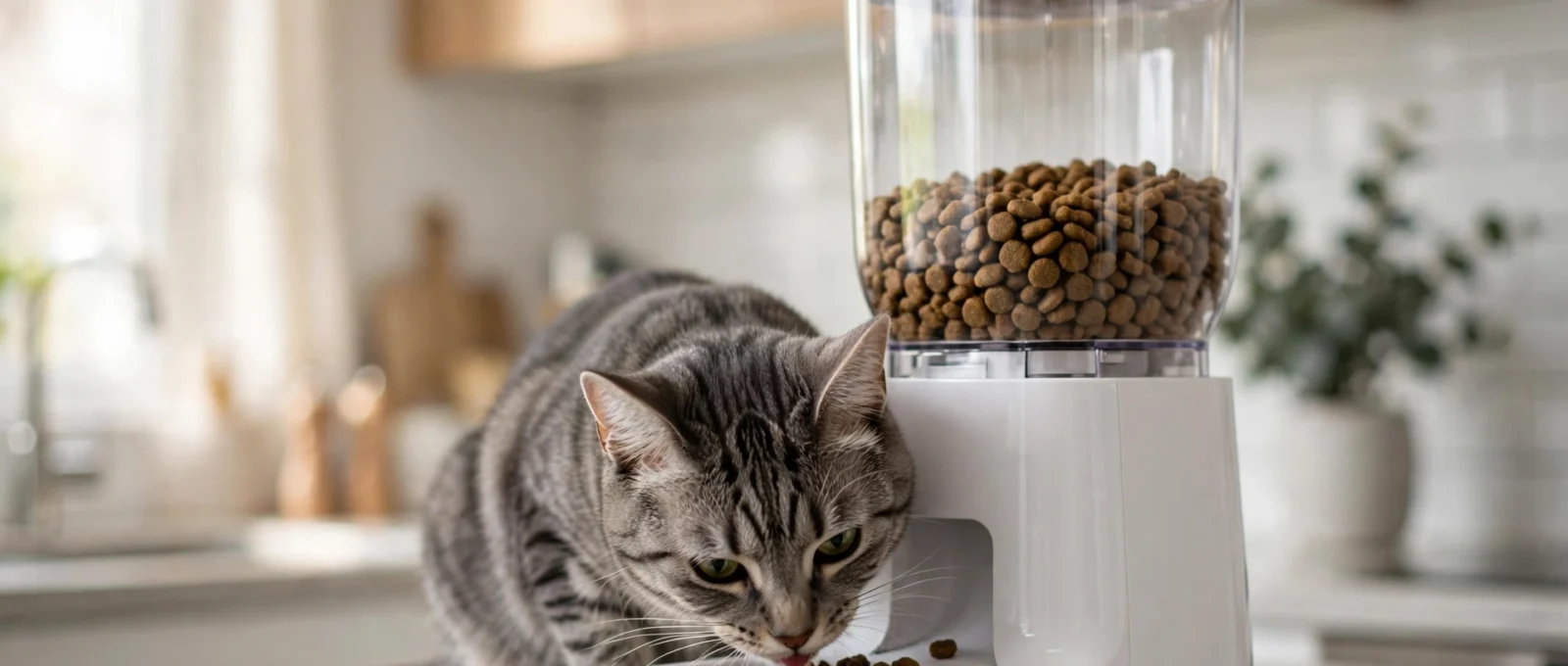
Whether you work long shifts, travel on weekends, or just have a cat that wakes you at 4 a.m. demanding breakfast, an automatic cat feeder can take the timing of meals off your plate. The best automatic cat feeders do more than dump kibble on a schedule — they control portions, keep food fresh, keep working through power blips, and (on the smart models) let you check in from your phone.
We looked at the models cat owners actually buy and recommend in 2026 — from PETLIBRO’s app-controlled lineup to the wet-food-friendly Cat Mate and the microchip-gated SureFeed — and picked 8 standouts across every budget and household type.
Quick Picks
| Feeder | Best for | Food type |
|---|---|---|
| PETLIBRO Granary WiFi Automatic Feeder | Best overall | Dry |
| PETLIBRO Granary Smart Cam Feeder | Best smart / camera | Dry |
| PETLIBRO Air WiFi Feeder | Best budget | Dry |
| Cat Mate C500 Automatic Pet Feeder | Best for wet food | Wet + dry |
| SureFeed Microchip Pet Feeder Connect | Best for multi-cat homes | Wet + dry |
| PetSafe Smart Feed Automatic Pet Feeder | Best portion control | Dry |
| PETLIBRO RFID Automatic Cat Feeder | Best selective feeding | Dry |
| Catit PIXI Smart Feeder | Best for Catit users | Dry |
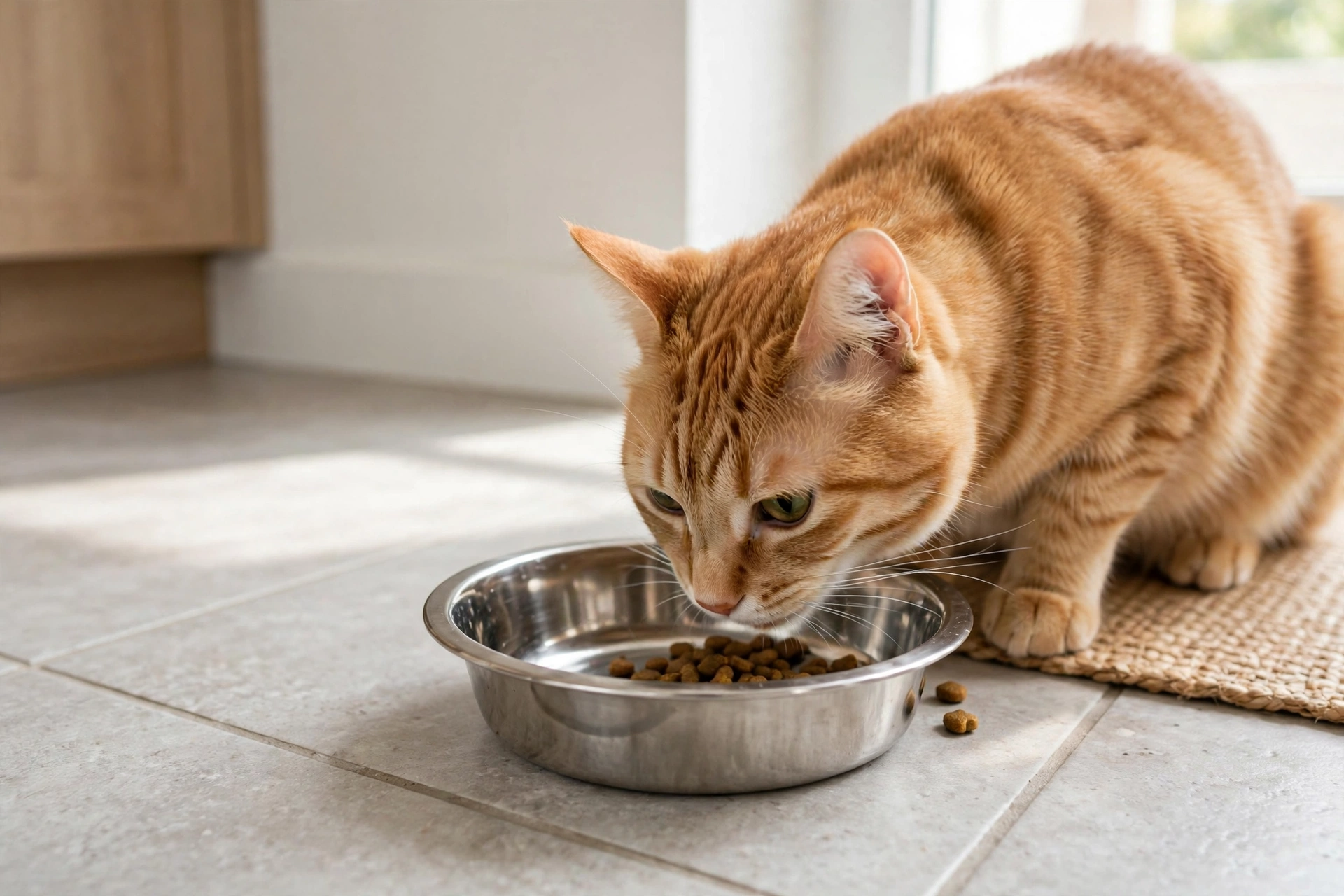
Best Overall: PETLIBRO Granary WiFi Automatic Feeder
PETLIBRO Granary WiFi Automatic Feeder
PETLIBRO has become the default recommendation in the automatic feeder world, and the Granary WiFi is the model that earned it. The 5-liter hopper holds enough dry food for a single cat for roughly two weeks, the app lets you schedule up to 10 meals a day with precise portions, and the twist-lock lid keeps food sealed and curious paws out.
What sets it apart from cheaper timed feeders is the combination of reliability and control: dual power (wall plug plus battery backup), a clog-resistant dispensing rotor, and feeding records in the app so you can see whether meals actually dropped. It’s the feeder we’d recommend first to most cat owners.
Best for: Most households — one or two cats on dry food who need dependable scheduled meals.
Pros: Large 5L hopper; app scheduling up to 10 meals/day; dual power backup; secure twist-lock lid; feeding history in app.
Cons: Dry food only; needs WiFi for app features; larger footprint than slim models.
Best Smart / Camera: PETLIBRO Granary Smart Cam Feeder
PETLIBRO Granary Smart Cam Feeder
If you want to actually see your cat eat while you’re away, this is the one. The Granary Smart Cam adds a 1080p camera with night vision and two-way audio to the Granary platform, so you can watch meals happen live and even talk to your cat through the app. It records short clips and photos, which is genuinely useful for spotting appetite changes — one of the earliest signs something is off with a cat.
You get the same core specs as the standard Granary (5L hopper, up to 10 meals a day, app scheduling, battery backup), plus motion detection alerts. It’s the priciest pick on this list, but for anxious owners or cats with health conditions worth monitoring, the camera earns its keep.
Best for: Owners who travel and want visual confirmation that meals happened — or who want an early warning on appetite changes.
Pros: 1080p camera with night vision; two-way audio; motion alerts and feeding records; same reliable dispensing as the Granary WiFi.
Cons: Premium price; camera features need solid WiFi; dry food only.
Best Budget: PETLIBRO Air WiFi Feeder
You don’t have to spend a lot to get scheduled feeding right. The PETLIBRO Air is the slim, affordable sibling in the Granary family: a 2-liter hopper, app control over WiFi, up to 10 meals a day, and PETLIBRO’s gentler dispensing mechanism that doesn’t fling kibble across the kitchen.
The tradeoff for the lower price is capacity — 2 liters is on the small side next to 5-liter competitors, so you’ll refill more often (roughly every 10-14 days for one cat). But the slim profile fits small kitchens, and the core job — meals on time, in the right amounts — works just as well as the bigger models.
Best for: Budget shoppers and small spaces; single cats whose owners refill regularly.
Pros: Affordable; slim space-saving design; up to 10 meals/day; gentle, low-mess dispensing; easy-clean removable bowl.
Cons: Small 2L hopper; dry food only; needs WiFi for full features.
Best for Wet Food: Cat Mate C500 Automatic Pet Feeder
Cat Mate C500 Automatic Pet Feeder
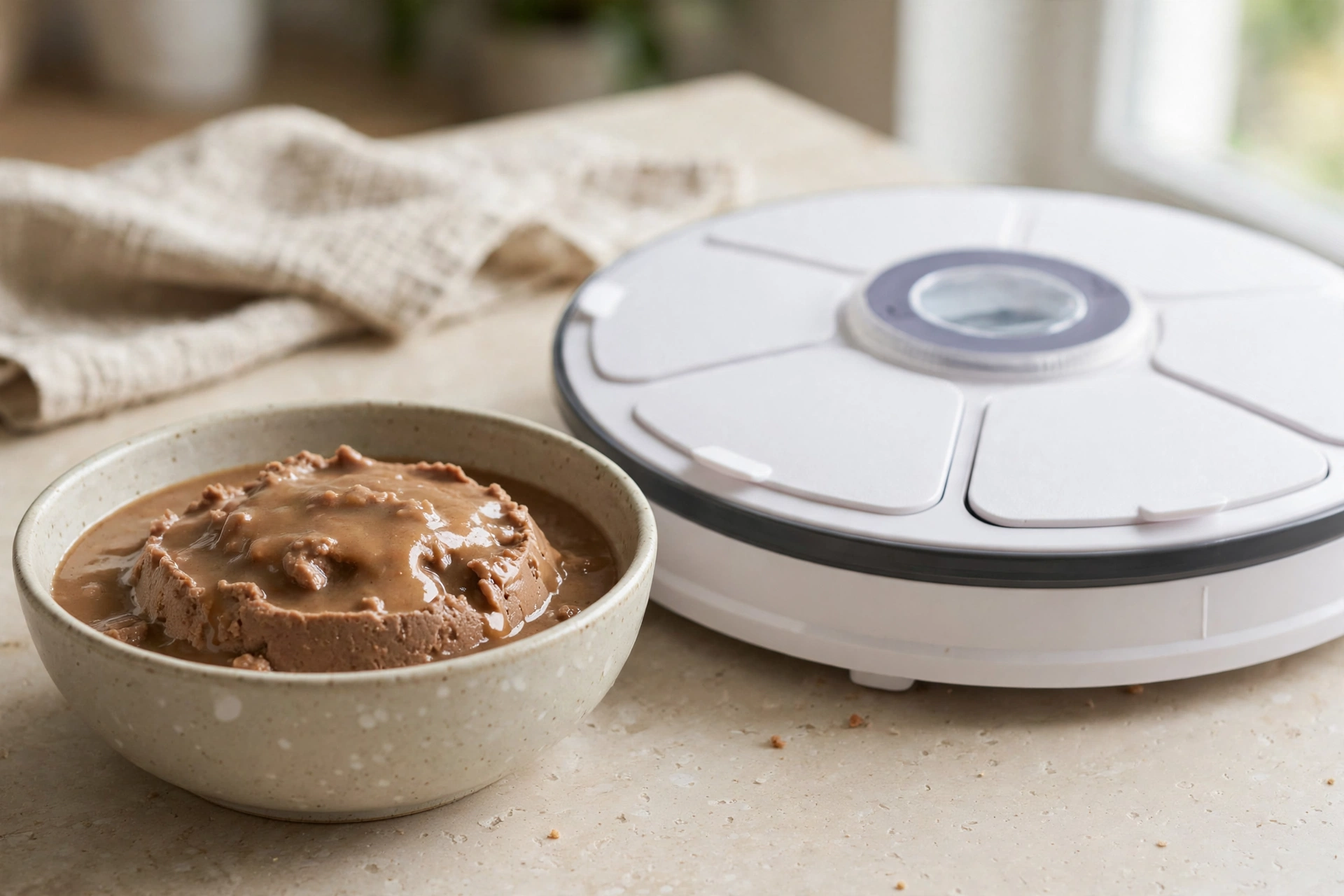
Here’s the honest truth about most automatic feeders: they’re dry-food only. Hopper mechanisms jam on wet food and can’t keep it fresh. The Cat Mate C500 is the long-standing exception — a rotary feeder with five covered compartments that rotate open on a timer, each holding a meal of wet or dry food.
It ships with two ice packs that sit under the compartments to keep wet food fresher for longer, which makes it the go-to for cats on wet diets whose owners work long days. It runs on batteries (no plug, no WiFi to fail), and the lids are fly-proof and reasonably tamper-resistant. Just keep expectations realistic: even with ice packs, wet food shouldn’t sit out all day — this is a timed-meal solution, not an all-weekend one.
Best for: Cats on wet or mixed diets; owners who want timed meals without WiFi.
Pros: Serves wet AND dry food; 5 timed compartments; ice packs included; no WiFi or plug needed; battery-powered.
Cons: Only 5 meals max; wet food still shouldn’t sit out more than several hours; no app or remote control.
Best for Multi-Cat Homes: SureFeed Microchip Pet Feeder Connect
SureFeed Microchip Pet Feeder Connect
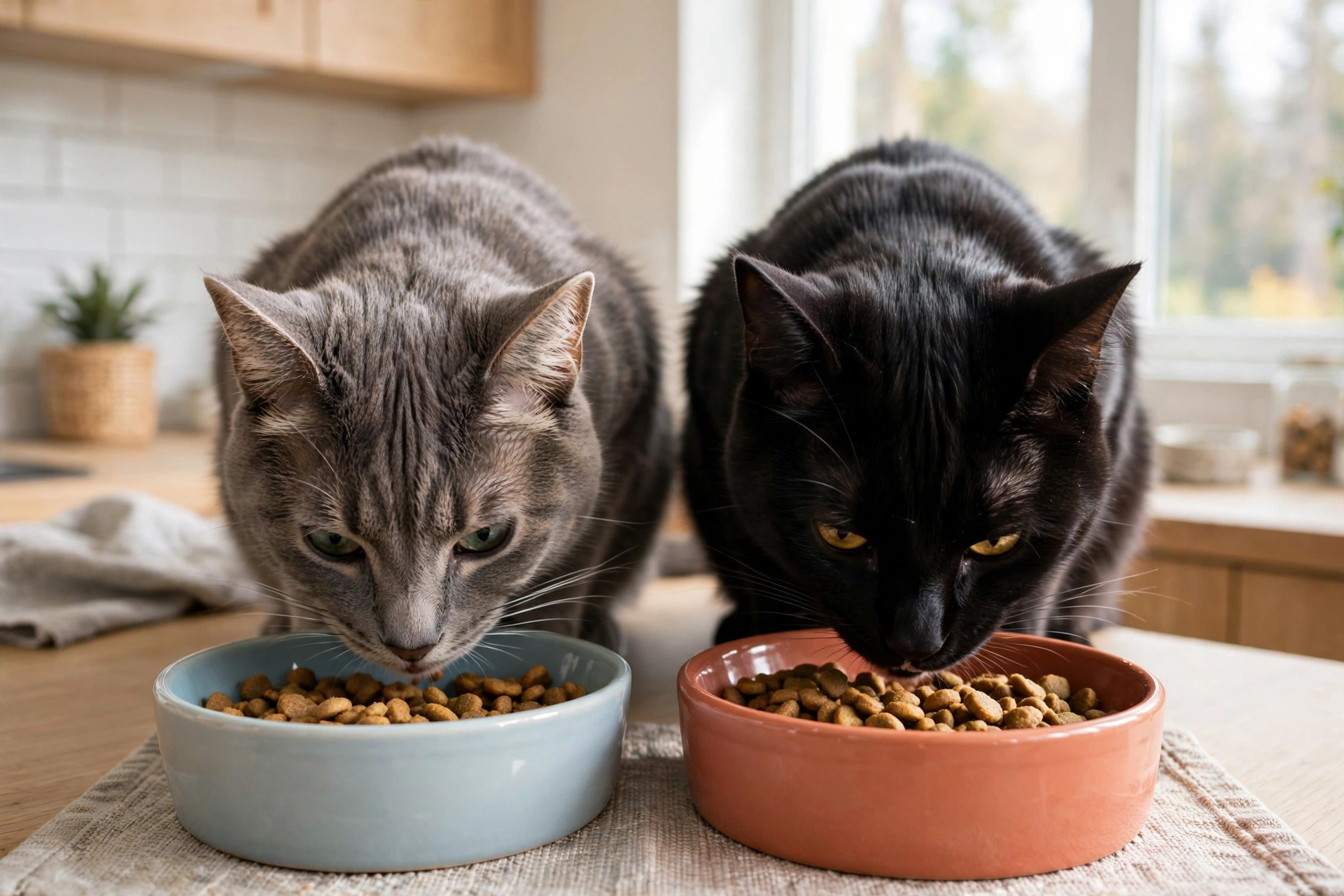
Multi-cat households have a problem no hopper feeder solves: one cat eats everyone’s food. The SureFeed Microchip Pet Feeder solves it with selective access — it reads your cat’s implanted microchip (or an RFID collar tag) and opens the sealed lid only for the registered cat. When that cat walks away, the lid closes, keeping the food fresh and the food thief out.
This is the feeder to buy if your cats eat different diets — one on prescription kidney food, one on regular kibble, for example — because eating the wrong food can be genuinely dangerous for cats with medical conditions. The Connect version adds app tracking of who ate how much, and a change in eating patterns is one of the earliest warning signs of feline illness. If your cats share one diet and don’t steal, a simpler feeder will do.
Best for: Multi-cat homes with different diets, prescription food, or a food-stealing problem.
Pros: Microchip-gated access stops food stealing; sealed lid keeps wet or dry food fresh; Connect app tracks intake per cat; essential for prescription diets.
Cons: One feeder per cat (costs add up); dry and wet both work but capacity is one meal at a time; setup
takes patience while cats learn the lid.
Best Portion Control: PetSafe Smart Feed Automatic Pet Feeder
PetSafe Smart Feed Automatic Pet Feeder
For cats on a vet-supervised weight-loss plan, precision matters more than cameras. The PetSafe Smart Feed schedules up to 12 meals per day — more than most competitors — with portions adjustable from 1/8 cup to 4 cups, so you can split the day’s calories into many small meals that mimic natural grazing without the overfeeding.
The app handles scheduling and sends low-food alerts, and the stainless steel bowl option is a nice touch for cats prone to chin acne from plastic. It’s a workhorse rather than a showpiece: fewer smart-home tricks than PETLIBRO, but dependable dispensing and fine-grained portions.
Best for: Overweight cats on measured meal plans; grazers who do best with many small meals.
Pros: Up to 12 meals/day; precise 1/8-cup portions; low-food alerts; large hopper options; stainless steel bowl available.
Cons: App is functional rather than polished; dry food only; bulkier design.
Best Selective Feeding (Dry Food): PETLIBRO RFID Automatic Cat Feeder
PETLIBRO RFID Automatic Cat Feeder
A newer alternative to the SureFeed approach: PETLIBRO’s RFID feeder uses lightweight collar tags instead of implanted microchips to grant access, opening only for the tagged cat. It’s a good middle ground if your cats aren’t microchipped or you want app-based diet tracking (the Pawsense app logs each cat’s intake) at a lower price than SureFeed’s Connect system.
The 3-liter hopper suits single or paired cats, the door mechanism is notably quiet (good for skittish cats), and there’s battery backup. The main caveat is the collar: the RFID tag needs a collar, and the included collar isn’t breakaway — swap it for a breakaway collar with the tag attached if your cat goes outdoors or you’re safety-conscious.
Best for: Multi-cat dry-food households that want selective access without microchip programming.
Pros: RFID selective access; quiet door; Pawsense app with diet tracking; dual-band WiFi; battery backup.
Cons: Requires collar tags (not breakaway by default); dry food only; occasional jamming with oversized
kibble.
Best for Catit Users: Catit PIXI Smart Feeder
If you’re already in the Catit PIXI ecosystem (their smart fountain is popular for a reason), the PIXI Smart Feeder slots right in with the same app. It’s a compact, friendly-looking dry-food feeder with scheduled meals, portion control, and a sealed lid — a solid everyday feeder rather than a category leader.
It won’t beat PETLIBRO on capacity or features per dollar, but for households that value one app for the fountain and the feeder — and Catit’s typically thoughtful, cat-first design — it’s a coherent choice.
Best for: Existing Catit PIXI owners who want one app for feeding and water.
Pros: Integrates with the PIXI app ecosystem; compact design; scheduled portions; sealed food storage.
Cons: Dry food only; smaller capacity than Granary-class feeders; fewer advanced features.
Buying Guide: What to Look for in an Automatic Cat Feeder
Portion control
This is the whole point. Look for feeders that let you set both meal times and meal sizes — ideally in small increments (1/8 cup or by the tablespoon). Cats generally do better with several small meals than one or two big ones, and precise portions are what separate a good feeder from a kibble firehose. If your cat is overweight, talk to your vet about daily calories first, then program that total across the day’s meals.
Timer and scheduling flexibility
Count the meals, not just the timer. Basic rotary feeders top out at 4-5 meals; smart hopper feeders typically offer 6-12. More meals mean smaller portions per meal, which suits grazers and weight-management plans. Check whether the schedule survives a power or WiFi outage — the schedule should live on the device, not in the cloud.
Power backup
A feeder that dies during a blackout and misses dinner is worse than no feeder. Prioritize dual-power models (wall adapter plus batteries) that keep dispensing on the stored schedule when the power — or the WiFi — goes out. Battery-only timed feeders like the Cat Mate sidestep this entirely.
Ease of cleaning
You’ll be washing the food bowl and wiping the hopper regularly. Removable, dishwasher-safe bowls (stainless steel is ideal) save real effort. Avoid feeders with crevices you can’t reach — dried kibble dust gets everywhere. As a rule, if you can’t easily take it apart, you won’t clean it often enough.
Wet vs. dry food
Be honest about your cat’s diet before you shop. Hopper-style smart feeders are dry-food only, full stop. If your cat eats wet food, you need a rotary timed feeder with covered compartments (Cat Mate C500) or a sealed microchip feeder (SureFeed) — and even then, wet food has a limited safe window at room temperature.
Multi-cat considerations
One feeder, two cats, one diet, no stealing? A single hopper feeder works. Different diets, prescription food, or a determined food thief? You need selective access — microchip or RFID — which means one feeder per cat. It’s the expensive answer, but it’s the only one that actually works.
Noise
Some feeders clunk loudly when dispensing, which can spook nervous cats — or teach bold ones to camp by the machine. If your cat is noise-sensitive, look for models known for quiet operation, and run the feeder for a few days while you’re home so your cat associates the sound with food, not alarm.
A Note on Safety
Automatic feeders are tools, not cat-sitters. They’re excellent for keeping mealtimes consistent while you’re at work or away for a day, but they don’t check water bowls, clean litter boxes, or notice that your cat seems off. For absences longer than 24-48 hours, arrange for a person to check in — and if your cat has a medical condition like diabetes that affects feeding, talk to your vet before relying on any feeder.
Feeding schedules also interact with health costs over time: consistent portion control helps prevent obesity, which is linked to diabetes and joint problems in cats — conditions that get expensive fast. (If you haven’t looked at it, our guide to pet insurance for cats with chronic conditions explains why enrolling before a diagnosis matters.)
Frequently Asked Questions
Are automatic cat feeders safe to leave with my cat?
Yes, for healthy adult cats, automatic feeders are safe when used as directed. Choose a model with a secure locking lid (so clever cats can’t pry it open), a battery or dual-power backup in case of outages, and food-grade materials. That said, feeders don’t replace human check-ins — if you’re away for more than a day or two, have someone look in on your cat.
Can automatic cat feeders dispense wet food?
Most gravity and hopper-style feeders are dry-food only — wet food spoils and clogs the mechanism. The exception is rotary timed feeders like the Cat Mate C500, which use separate covered compartments (with optional ice packs) to serve wet or dry food at preset times. Wet food shouldn’t sit out longer than a few hours, even with ice packs, so these are best for short trips or timed daytime meals.
How many meals per day should I schedule?
Most adult cats do well on 2-4 small meals per day rather than one big bowl, and many vets recommend this for weight management. Smart feeders typically allow 6-12 meals per day, which lets you mimic a cat’s natural grazing pattern while keeping portions controlled. Always follow your vet’s guidance on total daily calories — a feeder controls timing, not the right amount.
Will an automatic feeder help my overweight cat lose weight?
It can be a useful tool, but only as part of a vet-guided plan. Portion-controlled feeders remove the guesswork of free-feeding and stop the “just a little more” creep. However, the feeder won’t choose the right calorie target — ask your vet how much your cat should eat per day, then program that total across the feeder’s meals.
Do I need WiFi for an automatic cat feeder to work?
No. Non-WiFi timed feeders (like the Cat Mate C500) run on simple built-in timers and batteries — they work without any internet connection and keep running during WiFi outages. WiFi models add app control, remote scheduling, and notifications, but the core dispensing on most smart feeders also works on a stored schedule if the connection drops. If your internet is unreliable, prioritize a feeder with dual power (plug + batteries).
The Bottom Line
For most cat owners, the PETLIBRO Granary WiFi Automatic Feeder hits the sweet spot of capacity, reliability, and app control. Want to watch meals happen? Step up to the Granary Smart Cam. Feeding wet food? The Cat Mate C500 is in a class of one. And if your cats can’t be trusted around each other’s bowls, the SureFeed Microchip Pet Feeder Connect is the only real fix.
Whatever you choose, buy the feeder for the cat you have — the diet, the household, the schedule — not the features you’ll never use. And keep the food fresh, the bowl clean, and the portions honest.
Related reading: if you’re weighing the costs of cat ownership, see our guides to the cheapest pet insurance for cats and whether pet insurance is worth it for indoor cats — feeding right today can mean fewer expensive problems tomorrow.




Leave a Comment