
Introduction
If you need to know how to teach a dog to stay reliably — not the 3-second sit-stay that collapses the moment a squirrel appears, but a stay that holds — the problem is usually how it’s taught, not the dog. Most owners train stay as one behavior. Professional trainers train it as three separate skills: duration (how long), distance (how far you go), and distraction (what’s happening around). Master each D separately, then combine them. That’s the 3-D method, and it’s how you get a stay that works at the vet’s office, not just the living room.
The 3 Ds Explained
Duration: how long the dog holds position. This is trained first because it’s the foundation — a dog who can’t stay for 30 seconds at your side can’t stay for 10 seconds at 10 feet.
Distance: how far you move away. Added second, in tiny increments — one step back, then two. Distance is the D most owners rush, and rushing it is why stays break.
Distraction: what’s competing for the dog’s attention. Added last: first train in a boring room, then with mild distractions (a toy on the floor), then real life (other dogs, food smells, squirrels).
The golden rule: only ever increase one D at a time. If you’re adding distance, drop duration back to easy. If you’re adding distraction, drop both duration and distance. Every broken stay is information: you raised two Ds at once.
Phase 1: Duration (Days 1–5)
Start with your dog in a sit or down beside you. Say “stay” once (one cue, not a chant), wait 3 seconds, then release with an enthusiastic “okay!” and treat. The release word matters — it teaches the dog that stay ends when you say so, not when they decide.
Build: 3 seconds → 5 → 10 → 15 → 30 → 60. Only advance when the current duration succeeds 4 out of 5 reps. If the dog breaks, you went too fast — drop back to the last successful duration for several reps.
Key detail: reward while the dog is still staying, not just after the release. Walk back to them, treat in position, then release. This teaches that staying itself pays — otherwise dogs learn that breaking position is what earns the treat.
Pass criteria: 60-second stay at your side, 4/5 reps, in a low-distraction room.
Phase 2: Distance (Days 6–12)
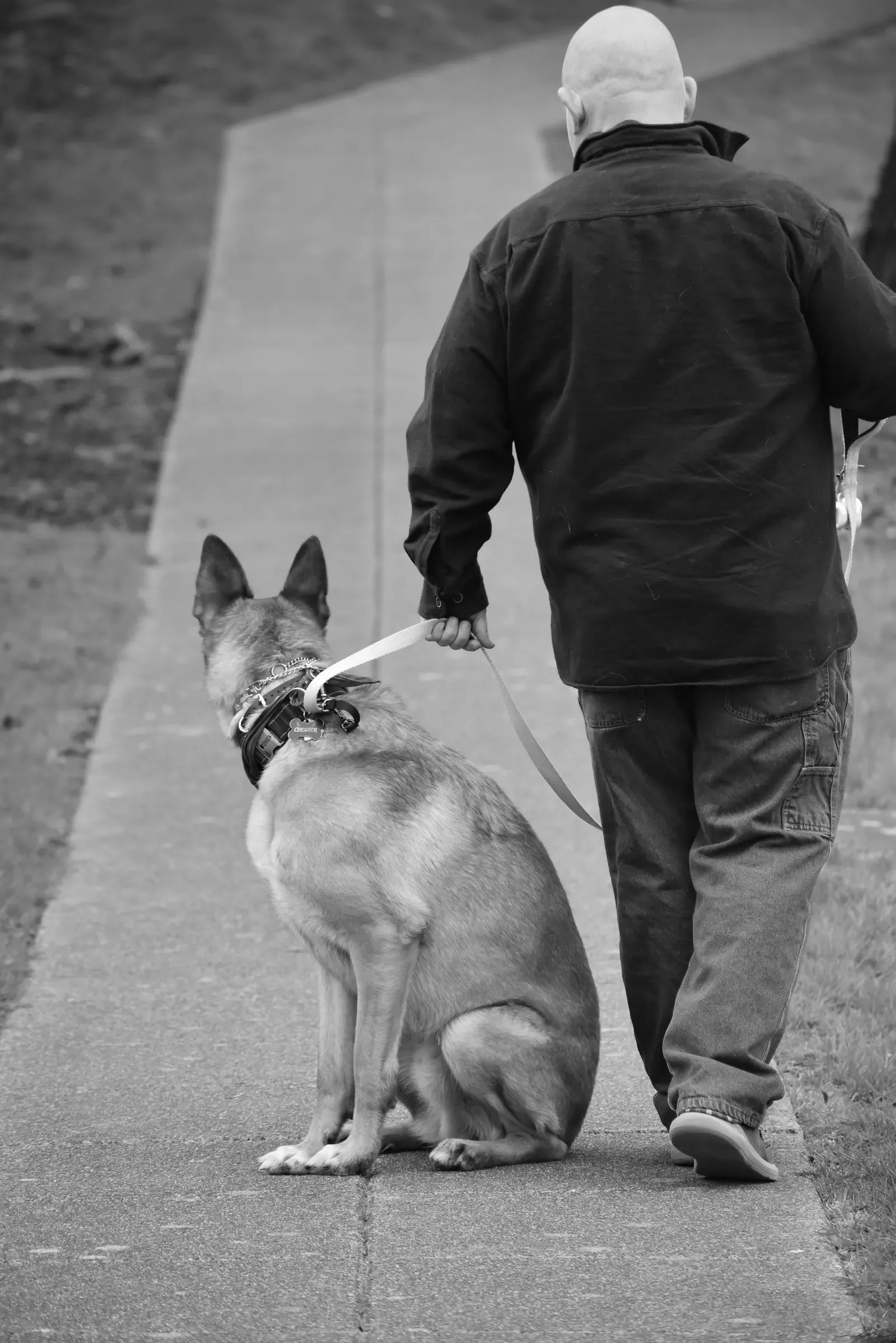
With a solid 30–60 second duration, add distance one step at a time. Cue “stay,” take one step back, pause 3 seconds, return, treat in position, release.
The most common error: walking away while facing the dog and then calling them to you. That teaches “stay means wait until I’m called” — which is a recall, not a stay. Always return to the dog to reward and release.
Build: 1 step → 3 steps → 6 steps → across the room → out of sight (briefly). Out-of-sight is its own milestone — start with 2 seconds behind a doorframe, not 30 seconds in another room.
Pass criteria: 30-second stay at 15 feet distance, 4/5 reps.
Phase 3: Distraction (Days 13–21)
Now proof against the real world, in this order:
- Mild: a treat tossed 6 feet away (on leash for safety), a family member walking past.
- Moderate: a toy squeaked nearby, food placed on a table at nose height.
- Real: another dog at distance, a squirrel-visible yard, the front door opening.
At each new distraction level, drop duration and distance back to easy (10 seconds, 6 feet). The dog is learning that the stay rule applies even when the world gets interesting — but they can only learn that if the other Ds are easy enough to leave brainpower free.
Pass criteria: 30-second stay at 10 feet with a moderate distraction present, 4/5 reps.
How to Teach a Dog to Stay: Putting the 3 Ds Together
Once each D passes separately, combine them gradually. A practical test sequence:
- Week 4: 1-minute stay, 10 feet, mild distraction
- Week 5: 1-minute stay, 15 feet, moderate distraction
- Week 6: 2-minute stay, 20 feet, real-world distraction (park edge)
Real-world reliability — the stay that holds when the leash drops or the front door opens — typically takes 6–8 weeks of consistent practice. That’s normal. A “stay” that only works in the kitchen isn’t trained; it’s rehearsed in one location.
Maintenance: once reliable, practice 2–3 times weekly in varied locations. Skills fade without use, and adolescence (6–14 months) often brings regression — just revisit the matrix.
The 3-D Training Matrix (Original Protocol)
| Phase | Duration | Distance | Distraction | Advance when |
|---|---|---|---|---|
| 1. Duration | 3s → 60s | At side | None | 60s, 4/5 reps |
| 2. Distance | 30s | 1 step → 15 ft | None | 30s at 15 ft, 4/5 reps |
| 3. Distraction | 10s → 30s | 6 ft | Mild → real | 30s + moderate, 4/5 reps |
| 4. Combined | 1 → 2 min | 10 → 20 ft | Real | Holds in 3 locations |
Troubleshooting rule: if the dog breaks twice in a row, drop whichever D you raised last. Two breaks = information, not disobedience.
Stay vs. Wait: Do You Need Both?

Trainers split on this, but here’s the practical distinction. “Stay” means hold this exact position until released — the dog shouldn’t shift from sit to down, for example. “Wait” means pause briefly, usually at thresholds: wait at the door, wait before jumping out of the car. Wait is shorter, more casual, and the dog chooses the position.
You don’t strictly need both cues when you’re learning how to teach a dog to stay — one solid stay with a clear release word covers most real-life needs. But adding “wait” later is cheap once stay is reliable, and it’s genuinely useful at doors, curbs, and car hatches where a formal stay feels like overkill.
Common Mistakes When Learning How to Teach a Dog to Stay
Everyone studying how to teach a dog to stay should avoid these —
Repeating the cue. “Stay… stay… STAY!” teaches the dog that the first three stays don’t count. Say it once. If the dog breaks, you asked for too much — adjust the Ds, don’t repeat the word.
Rewarding the release, not the stay. If the treat only comes after “okay!”, the dog learns breaking position is the paying event. Treat in position, then release.
Luring with the treat visible. Holding a treat in front of the dog’s nose during the stay teaches them to stare at your hand, not to hold position. Treats come from your pocket after the behavior, not as a bribe during it.
Training when the dog is wired. A dog fresh out of the crate with a full bladder and zoomies cannot learn duration. Exercise, potty, settle — then train. Tired dogs learn; wired dogs rehearse chaos.
Testing instead of training. Asking for a 2-minute stay “to see if they can do it” before building up to it just practices failure. Every rep should be set up for success — that’s what builds reliability.
FAQ
How long does it take to teach a dog to stay?
A basic 30-second stay takes 1–2 weeks; real-world reliability (holding around distractions at distance) takes 6–8 weeks of consistent practice. Rushing the phases is what stretches the timeline.
Should I use “stay” or just expect them to hold a sit?
Use an explicit stay cue. Dogs don’t generalize “sit means stay until released” reliably — a dedicated stay cue with a release word (“okay!”) is clearer and produces far more reliable behavior.
My dog stays until I turn my back, then breaks. Why?
You added distance and the out-of-sight element simultaneously — two Ds at once. Go back to in-sight distance work, then add 2-second out-of-sight reps separately.
Can I teach stay to a puppy?
Yes — start at 8–10 weeks with 3-second durations. Puppies learn the mechanics fast; the limitation is attention span, so keep sessions to 3–5 minutes. The impulse control from bite-inhibition work transfers directly.
What’s a “place” command vs. stay?
“Place” sends the dog to a specific spot (usually a bed or mat) and implies staying there; “stay” freezes the current position. Many trainers teach both — place is often more practical for doorbells and dinner time.
Got a new puppy? Training takes time, but vet bills happen overnight. Find out what pet insurance would cost for your breed with our free calculator: https://petsofweb.com/pet-insurance-cost-calculator/